2026-08-24 · 9 min read · Marco Island
How Does Boat Access Actually Work on Marco Island?
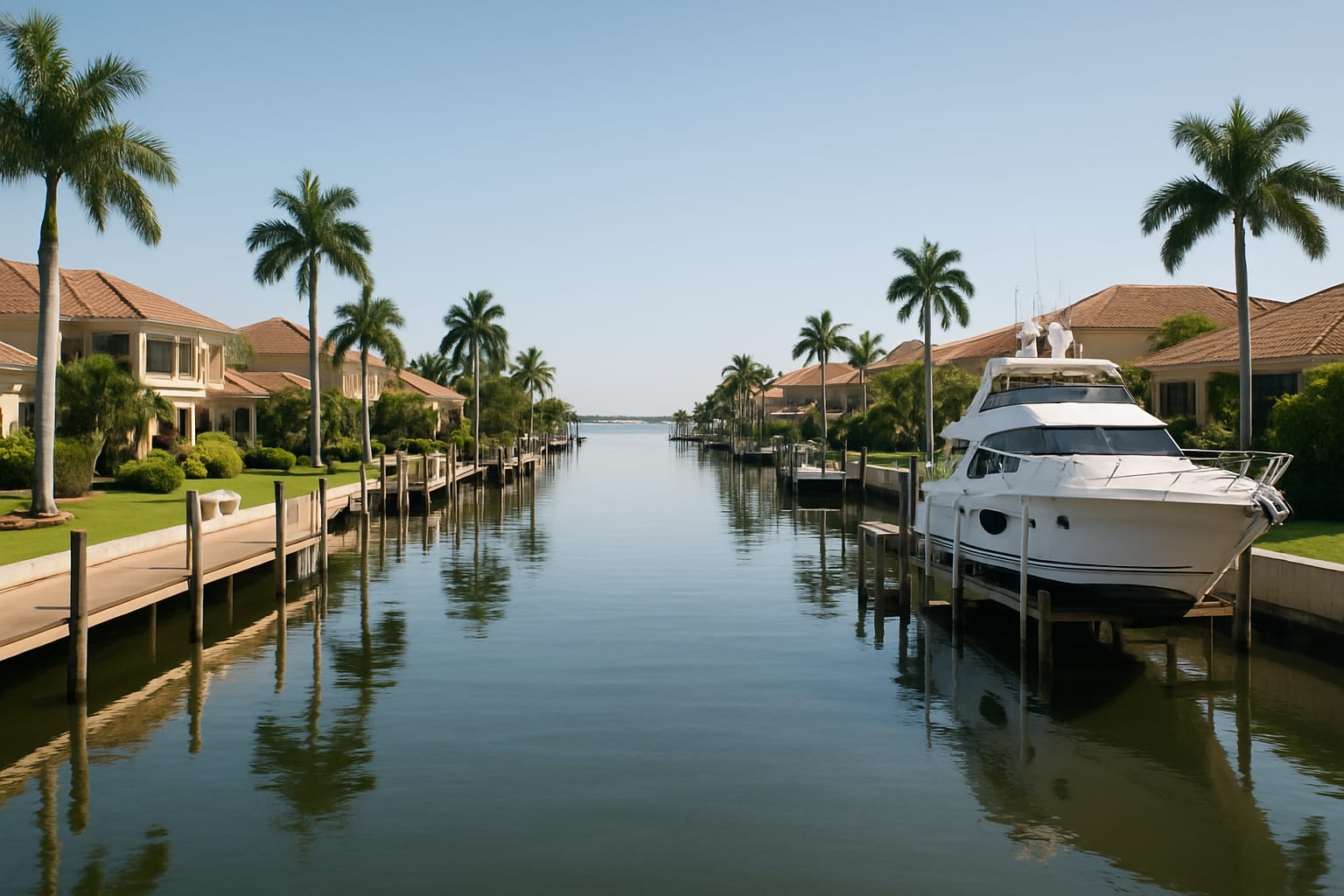
What does waterfront actually mean on Marco Island?
Waterfront is the least precise word in Marco Island real estate. It covers Gulf-front property, bay-front property, and canal-front property, and those three things deliver completely different boating, carry different costs, and attract different buyers.
I am Kris Asquith, a Broker Associate at Premiere Plus Realty, and I have sold across Marco Island and the eight other Southwest Florida markets I cover. The mistake I see most often here is a buyer comparing two listings that both say waterfront, assuming they are equivalent, and discovering after closing that one of them cannot accommodate their boat.
The variable that separates them is not the water at the back of the property. It is the route from that water to open water, and what sits along it. The Marco Island market overview covers how the island's neighborhoods differ; this article covers the question underneath most of them.
Why do bridges determine what boat you can own?
A fixed bridge between your dock and open water sets a permanent ceiling on your vessel height. No amount of money changes it. Tide affects clearance, so the number that matters is clearance at high tide, not the posted average, and the relevant measurement is your boat's air draft including antennas, hardtop, and tower.
This is why bridge-free access commands the premium it does. A property with no fixed bridge between it and the Gulf is not merely more convenient. It is available to a category of buyer that a bridged property is permanently closed to, and that buyer pool follows the property into resale.
If you already own a boat, measure it and bring that number to every showing. If you do not yet own one, decide the largest boat you might realistically want, then treat that as a filter rather than a preference. Buyers routinely purchase for the boat they have and regret it within two years. The distinction runs through how Marco Island boating homes are valued.
How much does canal depth matter here?
More than most buyers expect, and it is measured at the wrong time constantly.
Depth at low tide is the number that governs your access. A canal that looks generous at midday can be considerably shallower at low water, and a boat that draws more than the canal offers is a boat that leaves on someone else's schedule. Ask for low-tide depth at the dock and along the full route out, because a single shallow stretch anywhere between you and open water is the constraint, not the depth at your seawall.
Maintenance is the second half of this. Canals silt over time, and responsibility for dredging varies. Understanding who maintains the waterway, when it was last addressed, and what that costs is part of evaluating a canal property rather than an optional extra.
What is the difference between Key Marco, Old Marco, and the canal neighborhoods?
Marco Island is not one market, and the distinctions are real rather than marketing.
Key Marco is a gated waterfront community built around a yacht club, and it is one of the region's premier deep-water marine facilities. Properties there feature canal access through mangrove communities, private slips, and boat-friendly infrastructure. It attracts buyers for whom the marine capability is the point.
Old Marco is the historic waterfront area, with established single-family homes, boutique condo inventory, waterfront restaurants, and marina access. It carries strong character and a walkable waterfront feel that the newer canal neighborhoods do not replicate.
The canal neighborhoods deliver dock-at-your-door boating at a wider range of price points, with the bridge and depth questions above deciding which of them fits a given buyer.
Choosing between them is a boating decision as much as a housing decision, which is why I ask about the boat before I ask about bedrooms. The Marco Island Gulf access homes page breaks the tiers down further.
What should you verify before you make an offer?
Four things, all inside your inspection period rather than after it.
The route. Ride it, ideally at low tide. Confirm every bridge and every shallow stretch between the dock and open water.
The seawall. It has a service life and replacing one is a significant number. Cracking, bowing, and soil loss in the yard are the signals worth an expert opinion.
The dock and lift. Condition and rated capacity are separate questions. A lift rated below your vessel is a cost you inherit.
Insurance. Get a quote for the specific address, not an island estimate. Waterfront exposure and elevation drive the number, and it can change the math on a deal.
These belong in the diligence window described in the inspection step of the buying process, and they are specialized enough that you want them scheduled early rather than in the final days.
When is the best time to buy on Marco Island?
Marco Island runs on a season. Demand peaks from November through April, when the island fills and the largest share of the year annual sales volume transacts. Summer and early fall are quieter.
That rhythm creates a real tradeoff. Buying in season means more inventory to choose from and more competition for it. Buying off season means fewer choices but far less competition, and sellers who are still on the market in August are frequently more motivated than the same seller was in February.
For a boating buyer there is a second argument for the off season: you can inspect the water without the traffic. Riding the route to open water in July tells you more about depth and clearance than doing it during peak season, and you will get an unhurried look at the dock, the lift, and the seawall.
Neither window is automatically better. It depends on whether your constraint is selection or price, and that is worth deciding before you start touring rather than discovering mid search.
How does boat access affect resale on Marco Island?
Access quality follows the property permanently, which makes it one of the few features that is worth paying up for.
Bridge-free, deep-water access is scarce, cannot be manufactured, and opens the property to the widest buyer pool on the island. Constrained access narrows that pool to buyers whose boats fit, and a narrower pool is a slower sale and a softer number.
That is the practical case for treating access as a primary filter rather than a nice-to-have. When it is time to sell, the marketing job is reaching the specific buyer whose boat matches the property, which is the core of how selling a home on Marco Island works.
If you are weighing Marco against the smaller islands, Sanibel answers a different question, with conservation and quiet rather than marine capability at the center.
Thinking about buying or selling here? Get in touch or call (239) 300-1427, and bring the dimensions of your boat.