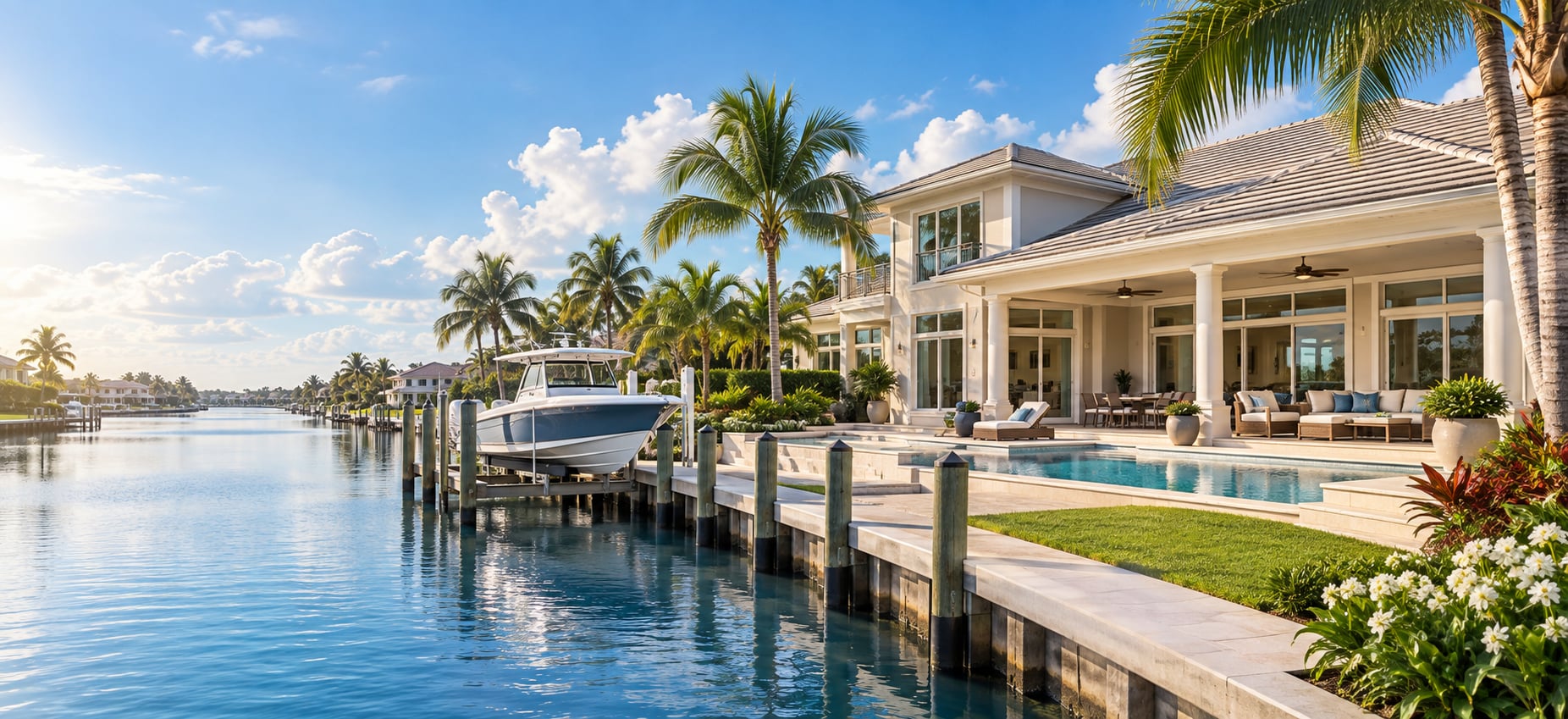
Gulf Access Homes in Southwest Florida
Homes with direct Gulf or canal access for boating, fishing, and waterfront lifestyle.
What does Gulf access actually claim?
That a boat can get from this property to open water. It is a claim about a route, not about a view, and routes have constraints.
Three of them decide everything. Bridges impose a fixed vertical limit, and a boat that does not fit under one does not pass regardless of anything else. Depth varies along a route and changes with tide, so a channel navigable at one hour is not at another. Distance and passes determine how long the run takes and how exposed it is.
None of that appears in the phrase Gulf access. Two properties can both use it truthfully and offer completely different boating.
I am Kris Asquith, Broker Associate at Premiere Plus Realty, working across nine Southwest Florida markets. On any purchase where boating is the point, I want the boat specification before the property list.
Verify Access for Your Boat
Why does direct access cost more than bridged?
Because it removes the constraint that cannot be worked around.
Direct access means no fixed bridge between the property and open water. Bridged access means at least one, and therefore a hard ceiling on vessel height. For a small center console that ceiling may never matter. For a vessel with a tower, a hardtop or a mast, it decides whether the property is usable at all.
This is why the same-looking canal home carries different value at different points along the same waterway, and why a buyer should never treat access as a yes or no question. It is a question about a specific boat.
Which markets actually have it?
They differ enormously, and being precise saves months.
Cape Coral is built on an extensive canal system designed for boating and carries the most Gulf-access inventory in the region. Fort Myers Beach works from the bay side of Estero Island through Matanzas Pass. Bonita Springs offers bayfront communities with routes out through the passes. Marco Island, Naples, Sanibel and Captiva each have their own arrangements and their own constraints.
Estero is the instructive exception. Gulf access there runs out through the Estero River, and the communities that have it work through on-site boat storage and a shared ramp rather than private docks behind the houses. Buyers assume Estero offers far more of this than it does.
How do you verify access properly?
Against your boat and the actual route, not against a description.
Start with the specification: length, beam, draft and air draft. Then trace the route from the property to open water and check each constraint along it. Where a bridge exists, get its clearance. Where depth is a question, understand how it moves with tide.
Ask the seller how they use the property and what they run, which is often more revealing than any document. Where a community controls dockage or launching, get the allocation rules in writing.
Do this before you write, not after. It is the one thing about a boating purchase that cannot be renegotiated later.
What else comes with saltwater access?
Cost, and it is predictable enough to plan for.
Salt reaches everything. Hulls, trailers, lifts, fittings, seawalls and engines all need more attention than they would in fresh water, and structures over salt water age in ways a general home inspection does not fully assess. Have marine structures evaluated by someone qualified to evaluate them, and establish who owns the seawall and who pays when it needs work.
Then quote insurance for the exact address, because proximity to open water and elevation both move it and wind and flood are frequently separate policies.
There is more on the physical side in boating homes and on the wider picture in waterfront homes. Get in touch or call (239) 300-1427 with what you run.
Frequently Asked Questions
What is the difference between direct and bridged Gulf access?
Direct access means no fixed bridge between the property and open water. Bridged access means at least one, which imposes a hard ceiling on vessel height. For a small center console that may never matter; for a boat with a tower, hardtop or mast it decides whether the property is usable at all, which is why the same-looking home carries different value along one waterway.
How do you verify a Gulf access claim?
Against your specific boat and the actual route rather than the description. Start with length, beam, draft and air draft, then trace the route to open water and check each constraint: bridge clearances, depth and how it moves with tide, and the passes. Where a community controls dockage or launching, get the allocation rules in writing.
Which Southwest Florida market has the most Gulf access?
Cape Coral, which is built on an extensive canal system designed for boating. Fort Myers Beach works from the bay side of Estero Island through Matanzas Pass, and Bonita Springs offers bayfront communities with routes out through the passes. Estero is the exception with just one genuine Gulf-access community.
Does Gulf access cost more to maintain?
Yes. Salt reaches everything, so hulls, trailers, lifts, fittings, seawalls and engines all need more attention than in fresh water, and structures over salt water age in ways a general home inspection does not fully assess. Proximity to open water and elevation also both feed insurance.
Who can help you verify Gulf access?
Kris Asquith, Broker Associate at Premiere Plus Realty, covers nine Southwest Florida markets. Call (239) 300-1427 or use the contact page with your boat's length, beam, draft and air draft, because access is a question about a specific vessel rather than a yes or no about a property.
Keep exploring
Ready to make your move with Kris Asquith at Premiere Plus Realty?