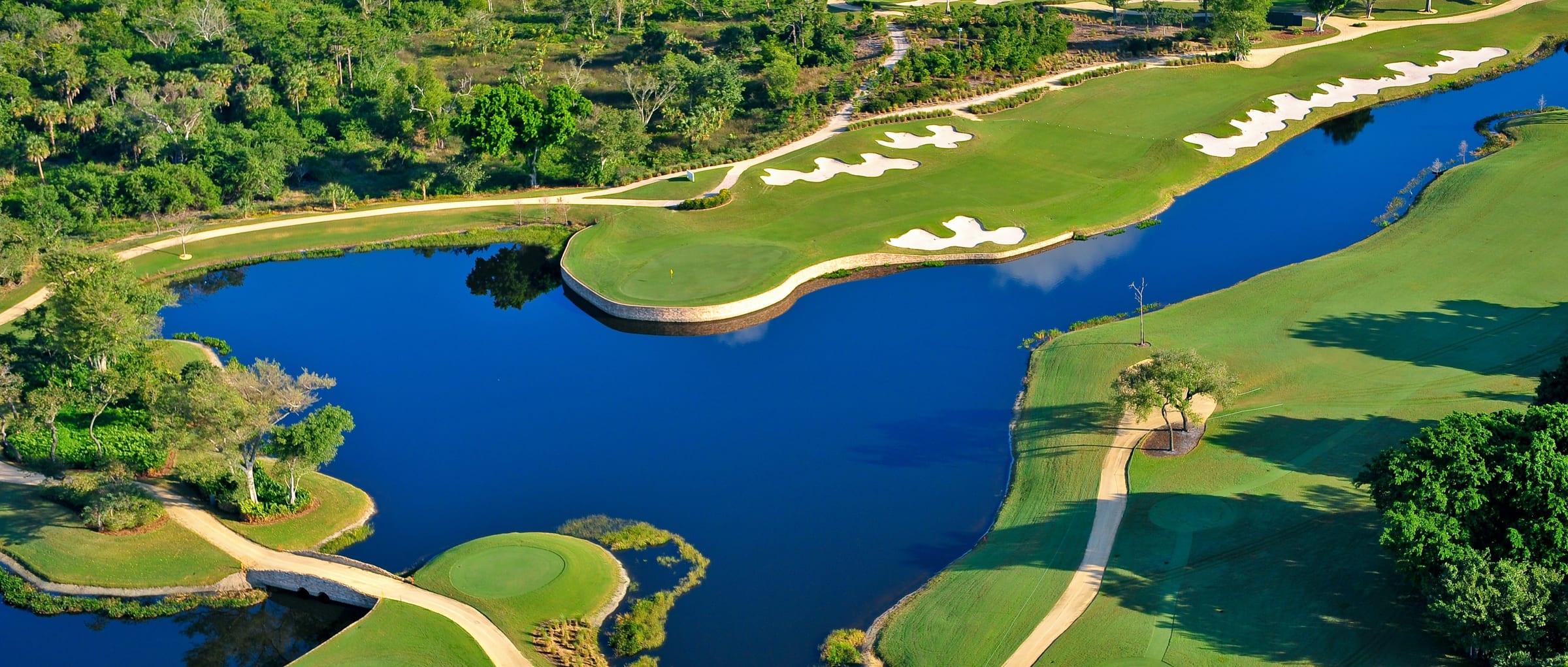
Bundled Golf Communities in Southwest Florida
Golf membership comes with the house, for everyone, whether or not you play. What that gets you and what it commits you to.
What does bundled golf actually mean?
It means the club membership is attached to the property rather than to you. Buy the home and you are a member from the day you close, whether that home is a single-family house, a coach home or a condo. Sell it and the membership goes to whoever buys it. There is no application, no waiting list and no initiation fee to negotiate, because there is nothing to join. It came with the house.
One distinction to get right early, because it decides what you are actually buying. The membership that comes bundled is either a golf membership or a social membership, depending on the community and sometimes on the specific address within it. Every homeowner is one or the other. A social membership carries the clubhouse, the dining and the social side without full golf privileges, so two homes in the same community can come with genuinely different access. Establish which one attaches to the property you are looking at rather than assuming the community has a single answer.
No initiation fee does not mean no cost. Annual dues are still required and they are not optional, which is the part covered below.
That is the whole mechanism, and it explains everything else about how these communities behave. Every owner is a member, so the club knows exactly what its income is. Dues are usually collected through the association rather than billed separately, which is why buyers sometimes do not notice them sitting inside the quarterly figure until they read the budget properly.
The part that catches people is the other side of the same coin: it is mandatory. Not optional, not opt-out, not reducible if you stop playing. If you buy in a bundled community and never pick up a club, you pay exactly what the person playing four times a week pays. That is not a catch or a loophole, it is the deal, and it is the right deal for a lot of people. It is simply worth understanding before you sign rather than after.
I am Kris Asquith, Broker Associate at Premiere Plus Realty, and I sell across nine Southwest Florida markets.
Talk to Kris About Golf Communities
Who is bundled golf right for, and who is it wrong for?
It is right for people who play, and it is very good for them. Golf that comes with the house removes the two things that make club access difficult in this region: the money you have to commit before you have played a single round, and the wait. In the equity clubs both of those are real, and in a bundled community neither exists.
It also suits people who want the club to be the center of the community rather than an amenity beside it. Because everyone is a member, the dining room, the events and the social calendar are shared by the whole community rather than by the subset that joined. That is a genuinely different feel from a community where the club is optional.
It is wrong for two kinds of buyer. The first is the buyer who does not play and does not intend to. Paying full dues for a course you will never walk is a poor use of money, and there are excellent gated communities in the same markets with no golf at all. The second is the buyer who wants scarcity: a course with a low member count, guaranteed tee times and the sense that access is the point. Bundled communities are the opposite of that by design, because every single home comes with a membership. Neither is better. They are different products, and the mistake is buying one while wanting the other.
Which communities here are bundled?
These are the bundled golf communities across the markets I work, grouped by area. 31 of them, and the list is names only for now: I am adding the property detail and current listings a handful at a time rather than putting up links that lead nowhere.
Bonita Springs and Estero
- Bonita National Golf & Country Club
- Copperleaf at the Brooks
- Country Creek
- Highland Woods
- Pelican Sound
- Spanish Wells Country Club
- Spring Run
- Vasari Country Club
- Worthington Country Club
Fort Myers
- Colonial Country Club
- Cross Creek Country Club
- Heritage Palms Golf Club
- Hideaway Country Club
Naples
- Cedar Hammock Golf and Country Club
- Cypress Woods
- Esplanade at Rivergrass
- Esplanade Golf and Country Club
- Forest Glen Golf & Country Club
- Foxfire Country Club
- Glades Country Club
- Glen Eagle Golf and Country Club
- Heritage Bay
- High Point Country Club
- Naples Heritage Golf Club
- Naples Lakes Country Club
- Panther Run Golf Club
- Royal Wood Golf & Country Club
- Stonebridge Country Club
- The National Golf & Country Club
- Treviso Bay
- Vanderbilt Country Club
Three of the Naples ones are worth a note now, each verified against the club's own information.
Heritage Bay in North Naples carries 27 holes rather than 18, laid out as three nines called Pine, Cypress and Oak and played in rotating eighteen-hole combinations. The courses were designed by Gordon Lewis and Jed Azinger. A golf membership attaches to every property in the community.
Cedar Hammock Golf and Country Club in East Naples plays 6,676 yards, also a Gordon G. Lewis and Jed Azinger design. More than half of the development is given over to preserves, lakes and wetlands, which is unusual density even by Collier County standards and shapes what the course feels like to play.
Vanderbilt Country Club in North Naples carries a Gordon G. Lewis signature course at 6,735 yards, par 72.
The pattern worth noticing is that those three share designers. Gordon Lewis and Jed Azinger built a great deal of the bundled golf in Collier County, so if you like how one of these plays there is a reasonable chance you will like the others. That is a more useful thing to know when touring than any ranking.
For the wider picture of the market, see golf communities in Naples.
What should you check before buying into one?
Four things, in this order.
How the dues are collected and what they cover. In some communities the golf dues sit inside the association assessment and in others they are billed separately. Both are normal. What matters is that you know the full annual figure before you are under contract, and that you know what it does and does not include, because cart fees, food and beverage minimums and locker or bag storage are often outside it.
What the club holds in reserves and what it has already spent. A golf course is an expensive asset with a replacement cycle. Greens get rebuilt, irrigation gets replaced, clubhouses get renovated, and every one of those is funded either from reserves or from an assessment on the members. Reading the reserve study tells you which of those is coming.
Whether any course work is planned or under way. A community mid-renovation is not a problem, but a season without a course is a season you paid dues for, and you should know about it in advance rather than discover it in October.
How tee time access actually works. Every home carrying a membership means the course is well used. Ask how the booking system works and how far ahead members reserve, because that is the practical difference between a course you can play when you want and one you plan around. Several bundled communities here run the Chelsea system for tee times, and it is worth understanding how a club uses it before you buy rather than in your first season.
What else the documents restrict. Buying into a bundled community is a more involved purchase than an ordinary one, and the surprises are rarely in the listing. Pet restrictions, which memberships attach to which addresses, and fees that sit outside the headline dues are all in the documents rather than in the brochure. Ask for the full picture in writing.
The inspection stage of the buying process is where the association documents get read properly, and in a bundled community those documents are describing a golf club as well as a neighborhood.
If you want to compare this against buying the house and the club separately, the equity golf clubs page covers how that works. Get in touch or call (239) 300-1427 and I will tell you which structure actually fits how much you play.
Frequently Asked Questions
Can you opt out of the golf membership in a bundled community?
No. The membership is attached to the property rather than to the owner, so every home carries one and every owner pays the dues whether they play or not. That is the defining feature of bundled golf, not a term that can be negotiated at closing.
Is there an initiation fee or a waiting list for bundled golf?
No to both, and that is the main advantage of the structure. There is nothing to join, because the membership transfers with the property, so there is no application, no approval and no wait. You are a member from the day you close.
Which Naples communities have bundled golf?
Heritage Bay, Cedar Hammock Golf and Country Club and Vanderbilt Country Club are three of them. Heritage Bay is unusual in carrying 27 holes rather than 18, laid out as three nines played in rotating combinations.
Does bundled golf make a home harder to sell later?
It narrows the buyer pool to people who want golf, because a buyer who does not play is being asked to take on dues for something they will not use. In practice these communities trade steadily, but the honest answer is that you are selling a house and a club membership together and the buyer has to want both.
What is the difference between bundled and equity golf?
In bundled golf the membership comes with the house and everyone has one. In an equity club you buy the house and then apply to the club separately, the membership is an asset you own a share of, and there may be a cap and a waiting list. They are different products aimed at different buyers.
The other ways golf membership is structured
Keep exploring
Ready to make your move with Kris Asquith at Premiere Plus Realty?