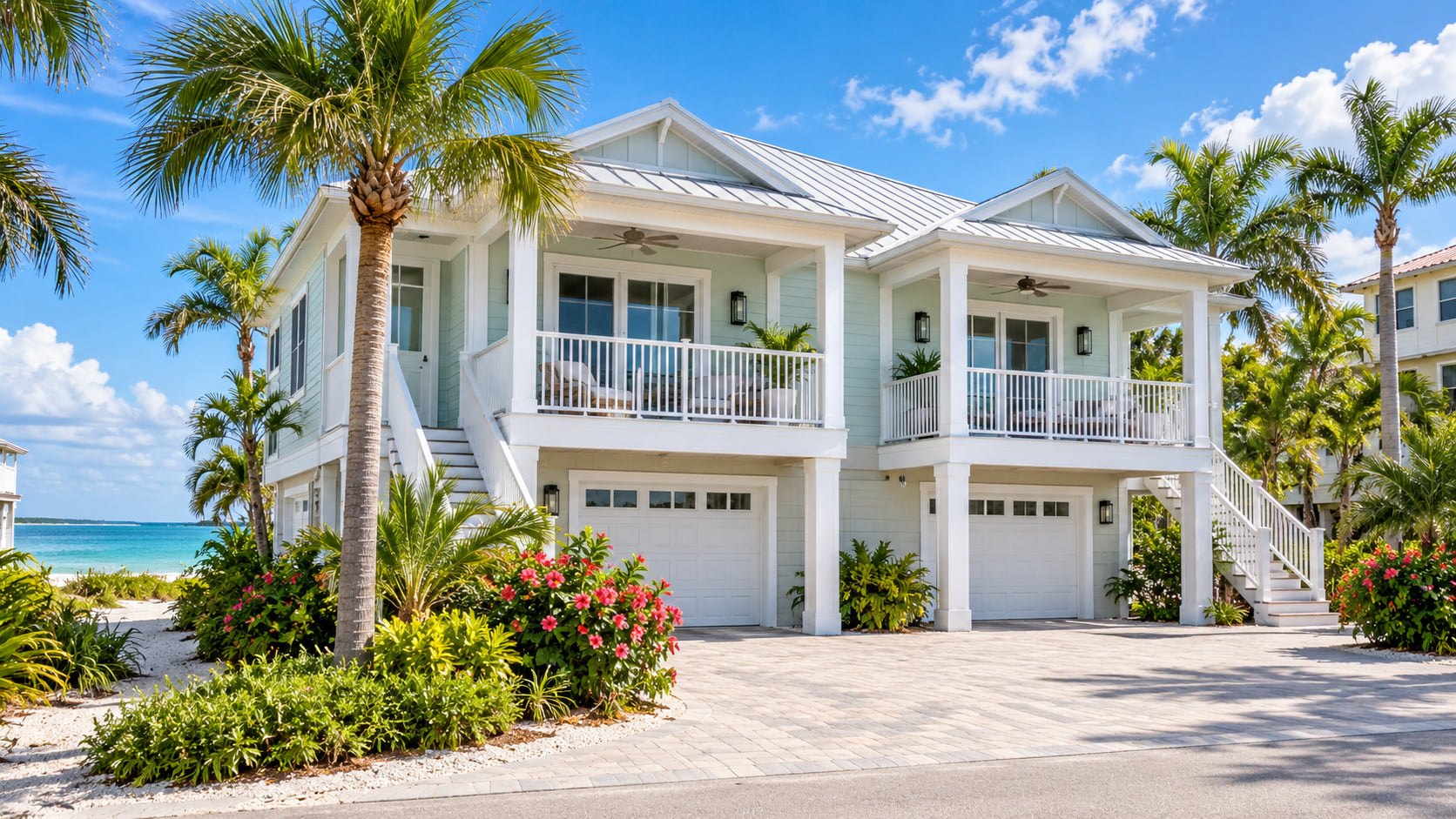
Investment Properties in SW Florida Two Units and Up
Property bought for return, evaluated on the numbers rather than the finish level.
What changes when you buy two units instead of one?
The thing being judged changes. On a house it is you. On an income property it is increasingly the building.
Buying one condo to rent out is a home purchase with a tenant in it. Move to two units and you are running something: two leases, two turnovers, two sets of appliances, and a set of documents that tells you more about the purchase than any photograph will. Move past four and the property is judged on what it earns almost to the exclusion of anything else.
Kris Asquith, Broker Associate at Premiere Plus Realty, works this alongside eight other specialisms across nine Southwest Florida markets, and spent eighteen years running a mortgage company. That is the relevant background here, because on income property the financing is not a detail attached to the purchase. It decides which properties are available to you before you look at one.
If you are buying a single unit rather than several, this is not your page. Condos and vacation and second homes cover that purchase properly, and the questions there are association rules and seasonality rather than the ones below.
Talk Through the Numbers
Where does the line actually fall between residential and commercial?
Between four units and five, and it is the most consequential line in this whole subject.
Two, three and four units are still residential. The loan is underwritten primarily on you: your income, your credit, your reserves. Terms are long, the paperwork is familiar, and the appraisal looks at what comparable properties sold for. A duplex is financed much more like a house than like a building.
Five units and above is commercial. The loan is underwritten primarily on the property: whether its income covers the debt payment with room to spare, which lenders measure as a debt service coverage ratio. Expect a larger deposit, a shorter term with a balloon at the end rather than a full amortisation, and a personal guarantee. Expect the lender to want the building's operating history, not only your tax returns.
So a fourplex and a six-unit building two streets apart can be completely different transactions at a similar figure. Buyers who have only ever bought houses tend to meet this distinction after they have made an offer, which is the worst possible moment. Settle the financing question first, which is where the buying process starts for exactly this reason.
How does the building actually get valued?
Two different ways, depending on which side of five you are standing.
Below five units the appraisal reverts to comparable sales, the same method used on a house. That cuts in a direction people rarely expect: it can make a good duplex harder to buy on the numbers, because the price is set by what the market paid rather than by what the building earns. A well-run property and a badly run one on the same street can appraise similarly.
At five and above, a commercial appraisal takes the income the property produces, subtracts the cost of operating it, and capitalises what is left. Comparable sales inform the rate applied, but the engine is the property's own performance. The consequence is worth sitting with: on a house you wait for the market to move, and on a commercial income property you can move the value yourself by raising income or reducing expenses.
It also means a seller's asking figure is an opinion about their operating numbers, and those numbers are the thing to test. A building priced on rents nobody is actually paying, or on expenses that quietly omit management, vacancy and reserves, is priced on fiction. It does not become worth less when you discover that. It was never worth the number.
What do you need to see before you make an offer?
The operating reality, in documents, rather than the story in the listing.
Ask for the rent roll: every unit, what it actually rents for, lease start and end dates, deposits held, and which units are vacant. Ask for the trailing twelve months of operating statements rather than a projection, because a projection is a wish and a twelve-month record is a record. Ask what is included in the rent and what the tenant pays separately, because a property where the owner covers water and rubbish is not comparable to one where the tenant does, whatever the headline rent says.
Then verify rather than accept. Estoppel certificates signed by each tenant confirm what the occupant believes their agreement says, which is not always what the seller's spreadsheet says. Bank deposits confirm rent is being collected rather than merely owed. Vacancy is not the only leak: a unit renting well below the others usually has a reason, and it matters whether that reason is condition, a long-standing arrangement, or a lease you are about to inherit.
Walk every unit, not a representative one. Deferred maintenance is rarely evenly distributed, and the unit nobody is keen to show you is the one that tells you what the roof, the plumbing and the previous management have actually been like.
What does coastal insurance do to the numbers?
On this coast it stops being a line item and becomes a deal term.
Insurance sits inside operating cost, and above four units operating cost feeds directly into what the building is worth. So an insurance figure is not simply something you absorb. It changes the appraised value, which changes the loan, which changes what you can pay. A seller's operating statement carrying last year's premium on a policy you will not be offered is one of the more expensive things to find late.
Get quotes on the actual property during your inspection period rather than assuming continuity, and on the terms you will genuinely be offered. Elevation, construction age, roof age and condition, and distance to open water all move the number, and wind and flood are frequently priced separately from the general policy. A property whose roof is near the end of its life is a different insurance proposition from one whose roof was recently replaced, and that gap can exceed what the roof itself would cost to replace.
Which of the nine markets carries this kind of property?
Not all of them, and the reason is zoning rather than demand.
Multi-unit residential exists where land use permits it, which is a matter of municipal record rather than of how a market feels. The barrier island markets are overwhelmingly single-family and condominium, so multi-unit buildings are scarce there whatever an investor might want. The mainland markets carry considerably more. That is a starting point rather than an answer, because within any one city it varies street by street, and a parcel's zoning and any non-conforming use attached to it are things to confirm in writing rather than infer from what is standing next door.
The practical consequence is that a search for income property here runs across cities rather than within one. Cape Coral and Fort Myers are the usual starting points, with Bonita Springs and Estero worth reading for how differently the same purchase behaves a few miles apart.
Tell me what the money is meant to do and I will tell you which of the nine actually has the property, including when the answer is that none of them has what you are describing.
What should you do first?
Establish the financing before you look at buildings, because it decides which buildings are real for you.
If you might go past four units, talk to a lender who writes commercial loans rather than only residential ones, and find out what they will underwrite and on what terms. That conversation tells you whether five and up is available to you or whether four is your ceiling, and those are different searches with different economics. Have it before you fall for a building.
Then get representation in place. Income property is negotiated on documents and operating numbers rather than on finishes, and the diligence period is where the money is made or lost. More on how that runs is on the buying process page.
One thing I will not do is model returns that only hold in a good year. If the numbers work only when nothing goes wrong, they do not work. Bring me a property and I will read the rent roll and the operating statements with you before you write anything. Get in touch or call (239) 300-1427.
Frequently Asked Questions
Is a duplex financed like a house or like a commercial building?
Like a house. Two, three and four units all qualify for residential financing, underwritten mainly on your income and credit, with long terms and a comparable-sales appraisal. Five units and up moves to commercial financing, underwritten mainly on whether the building's income covers the debt, usually with a larger deposit, a shorter term with a balloon, and a personal guarantee. Buyers stepping up from single properties often meet this distinction after making an offer, which is the worst time to meet it.
What is a rent roll, and why does it matter more than the photographs?
A rent roll lists every unit with what it actually rents for, the lease dates, deposits held and which units are vacant. It is the closest thing to a valuation input there is on an income property, and above four units it feeds the appraisal directly. Photographs tell you about condition, which matters, but a well-presented building operating below its rents is worth less than a plain one operating at them. Ask for the trailing twelve months of operating statements alongside it: a projection is a wish, a twelve-month record is a record.
Do the existing leases survive the sale?
Generally yes. Buying an occupied property means buying the leases attached to it, including terms you would not have agreed and rents you would not have set. That is why estoppel certificates signed by each tenant matter: they confirm what the occupant believes their agreement says, which is not always what the seller's spreadsheet says. Confirm the specifics with your attorney rather than relying on a general answer, because how a particular lease and any local ordinance interact is a legal question rather than a real estate one.
Can you short-term rent a multi-unit property in Southwest Florida?
It depends on the municipality and on the specific parcel, and it must be confirmed before any part of your plan depends on it. Short-term rental regulation is set locally and varies between the cities on this coast, and a use permitted on one parcel may not be permitted on another nearby. Where you own the whole building there is no association to ask, which removes one obstacle and puts the entire question onto the local ordinance and the zoning. Get the answer in writing from the municipality rather than from a listing description.
Who can help evaluate a multi-unit purchase in Southwest Florida?
Kris Asquith, Broker Associate at Premiere Plus Realty, covers nine Southwest Florida markets and spent eighteen years running her own mortgage company, which is the relevant background on income property: the financing structure determines what is buyable before anything else does. Call (239) 300-1427 or use the contact page, and bring the rent roll and the operating statements rather than the listing photographs.
Investment - 2 units or more by neighborhood
Keep exploring
Ready to make your move with Kris Asquith at Premiere Plus Realty?